


LBF at the Lake III
12 June - 14 September, 2025
Annice Fell, Jelly Green, Hélio Luis, Lizbeth Mitty, Min Woo Nam, Wenhai Ning, Gaia Ozwyn, Luke Silva, Yoab Vera, Maria Kreyn and Yeji Sei Lee.
An essay by Matthew Holman.
This summer’s iteration of LBF at the Lake gathers eleven painters on a body of water in Muskoka, Ontario, beside its dense stands of trees, wide lakes, deep marshlands, and open northern skies. For generations the region has shaped how artists imagine the Canadian landscape, not only as scenery (sublime or sentimental) for Sunday painters out on Algonquin Lake, but as a space of brooding atmosphere, expansive scale, and shifting light, akin to the bohemians of Skagen in the 1880s or William Johnston’s abstract landscapes of the Scottish borders. The exhibition takes inspiration from the poetry of Emily Pauline Johnson (Tekahionwake), a corpus of writing that often returns to the wetlands and waterways of this rugged corner of the world. In her poem ‘Marshlands’, she writes of ‘A thin wet sky, that yellows at the rim, / And meets with sun-lost lip the marsh’s brim.’ With those plosive and tactile sounds, Johnson describes an almost cylindrical bigness of a place that feels at once quiet, expansive, and alive with subtle movement, as her lines evoke a landscape that resists clear edges or fixed viewpoints, just like the artists on display.
With this couplet in mind, look first at Yoab Vera’s Daydream: aroma del tiempo (2025), which gives us Johnson’s yellowing rim almost word for word: a coral sun set directly on the waterline, its rays fanning up through a sky of lilac and rose while the lower half settles into beaten gold. Here is the sun-lost lip meeting the brim of the world in a single band of light, what Vera himself describes as ‘haptic contemplative painting.’ Vera builds the surface from oil-stick and concrete, so the radiance carries a grain under the hand, a warmth you could almost touch. The horizon holds, fixed and luminous, at the very moment (to paraphrase Willem de Kooning) of a rosy-fingered dawn announcing itself as a new day. Min Woo Nam works the same dissolving edge and drains the heat from it. To look at My Khe II (2025) is to find that edge–here pinky-grey, not yellow, like a hazy mist before the seasonal storm to cull the heat–already absented into the amorphous environment which engulfs all reference points. A wash of dusty pink settles across the upper canvas and sinks through mauve into a cold grey-blue. Nam works in thinned, accumulated layers, each pass softening the one beneath until the linen seems to hold its own light as opposed to serving as a medium for the light’s reflection. All the energy of the painting takes place on that furtive horizon line, a band of water below a band of sky that the surface declines to separate. Named for the beach at Da Nang, My Khe II carries the wet, yellowing sky of Johnson’s marsh into a different, and more alienating time, staging a compelling composition of pure abstraction that nevertheless retains some semblance of the environmental conditions of land and sky and water. Two painters hold the horizon at a moment of precipice or sudden change: Vera’s dawn breaking open, Nam’s pre-storm grey holding its breath.
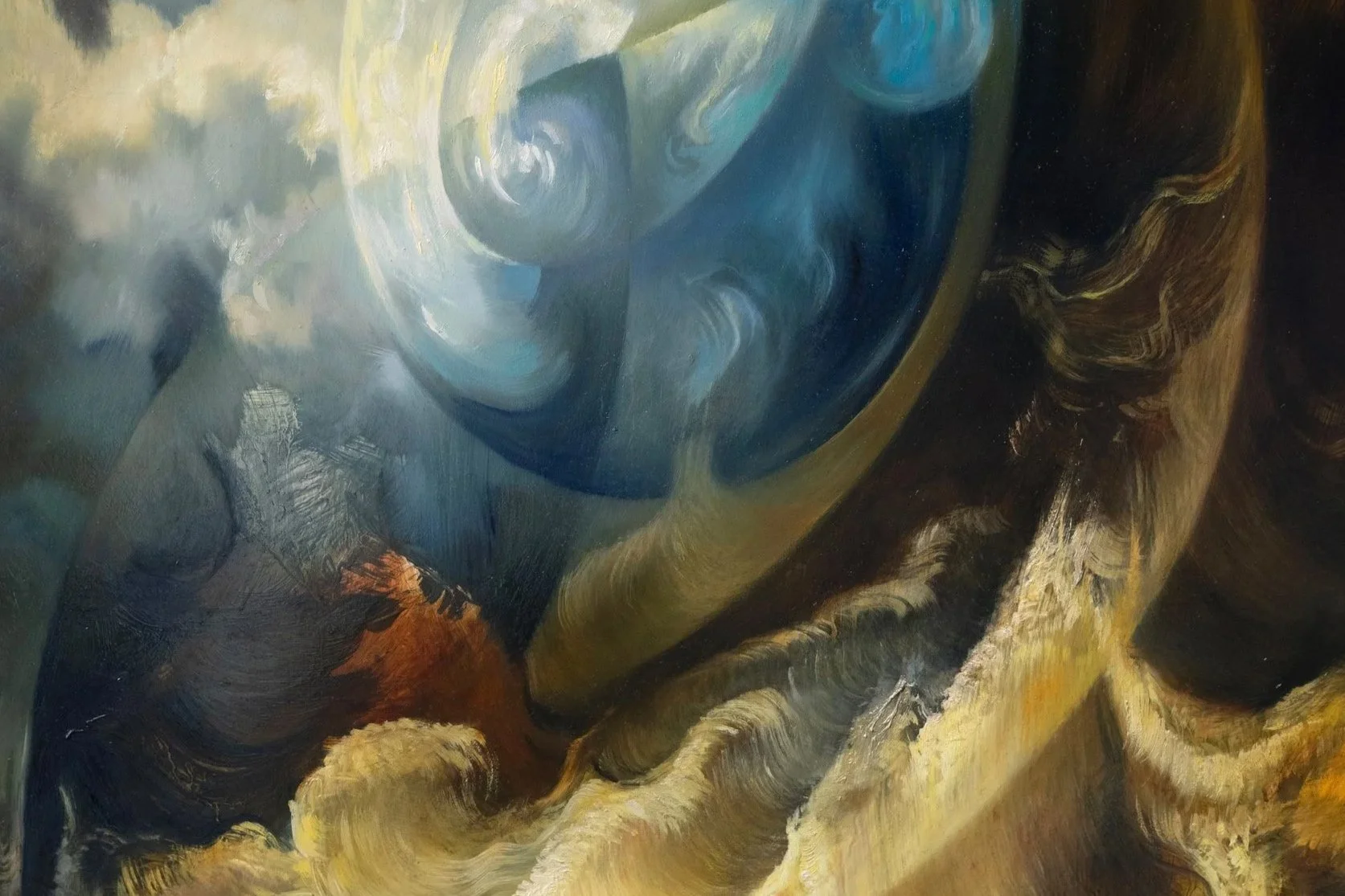
The four elements serve as the show’s premise. Water is the first thing here, but it is never the only thing. Set Maria Kreyn’s Visitation (2026) beside Wenhai Ning’s Emergence (2026) and you have already crossed from one element into another: Kreyn’s panel holds a rising orb above a sea churned into golden combustion, cloud and water and a kind of light that behaves like fire, while Ning’s surface resembles the underside of a lake surface, all deep and choking aqueous oils and swirling turquoise. Then water turns sombre, a site of quiet communion. Yeji Sei Lee’s Two at the Isar (2025) finds us at the edge of that Alpine river running down into the Danube. An elderly couple sit on a fallen trunk with their backs to us, smartly dressed in fresh pastel cottons, looking out onto a current that also seems to hold them adrift like a precarious island at the mercy of the flow. I am drawn to the texture of the linocut along the central horizon, where river meets undergrowth at the reedy feet of the forest. The world here is Edenic yet filthy, the algal green and the silt that no sense of pastoral calm can rinse out. Annice Fell’s paintings work in a similar way: the earthy textures seem seeped in sediment, surfaces pressed down and scraped back until they keep the whole record of their making. Fell builds by transfer first. She presses wet paint between sheets, so the opening marks arrive by accident, then answers them with oil stick and pastel, closing some forms and reopening others according to what the accident has already put down.
The elements arrive differently in Hélio Luis and Lizbeth Mitty, whose works, unlike much of the rest of the display, feel marked by the forces of history, capital, and the built world. Luis paints a single palm at night, its fronds dragged in deep blue and purple with yellow scored through the dark like phosphorescence. Palmeira (2026) looks lush at first glance and turns uneasy the longer you hold it. Luis, who came to painting from nuclear physics and works from old films and archival photographs, is drawn to how the tropical palm became a European fantasy, a stand-in for the ‘exotic’ that colonial image-making could possess. The water glinting at the base of the trunk is unlikely to be a Muskoka lake but somewhere far warmer; our eyes slip as we try and make sense of where we are, and that slippage calls our attention to the landscape as something never independent of politics, instead subsumed into the service of fantasy and extraction. Lizbeth Mitty insists on the contours of the world as we know it even as she shows it coming apart. Blue Oyster Cult (2025) is a gilded rococo room caught mid-ruin, its gold cornicing dripping, purple drapery bleeding down the walls, the ceiling torn open onto a bruised painterly sky. (But is art imitating the landscape here, or is the landscape subsumed, as art, into this gaudy fakery?) Mitty has spent five decades in New York painting decay as a kind of dark glamour, beauty and apocalypse held in one frame. Sunflowers (2025) turns that charge onto a still life: a single acid-yellow bloom flaring out of a green glass vase beside a guttering candle, the whole surface worked into thick troughs and ridges. Where the elemental paintings dissolve their edges and lose forms to a consuming frame of abstraction, Mitty holds onto cornicing and upholstery, the furniture of a world she paints in the act of falling apart. The lake, in her hands it seems, is the storm seen through a window, weather pressing at the glass of a room.
Fire consumes several works here, above all Luke Silva’s: watercolours of wildfires and burning barns that hold the elemental sublimity of a world increasingly on fire. In Wildfire Landscape (2024) a lone tree stands against a wall of orange, the watercolour bled and scorched until the medium itself seems to catch alight. Barn Fire (2023) sets its blaze against cold blue winter and snow, the flame reading at once as ruin and as beacon. Where Silva paints the fire as a kind of cinematic and catastrophic event, Jelly Green paints it as substance, material and raw. Her two canvases here come from a body of work made in answer to the wildfires eating the world’s forests, and they push right up to the moment the blaze takes hold. Alight III (2025) is built almost entirely in red, the oil dragged and clotted into ridges with veins of gold breaking through, so the surface reads as a forest already inside the flame. Incandescent VI (2025) opens that heat from its centre, a molten core of orange and yellow spreading toward the edges as if the canvas were burning in real time. Green has spent years among the rainforests she paints, and the loss is in the handling itself: the paint built so thick and worked so hard that the surface seems at risk from its own subject, holding the fire just long enough for us to see it.
Gaia Ozwyn closes the show in the space between elements, where one thing turns into another and nothing holds its edge. Her paintings are weather, or something older than weather: vast billowing masses of pigment that could be gas or the inside of a body. Words still cascade here (2026) opens a bright tear of light near the top and lets the colour pour down from it, reds and greens churning through a haze that never resolves into ground or sky. We rest on shifting sands (2026) is quieter and stranger, its forms drifting like a nebula caught mid-collapse, the title admitting that whatever footing we think we have is already moving beneath us. Ozwyn trained in medicine before she came to paint, and the knowledge shows in how she treats matter as something living and provisional, forever on its way to becoming something else. Johnson saw that seam a century ago, in her poem ‘Shadow River’, dedicated to Muskoka, watching a fern-leaf kiss its own reflection until the border line ‘the keenest vision can’t define.’ Every painter in Muskoka this summer has been working that same blur.
— Matthew James Holman, 2026