Not All Smoke and Mirrors: Mircea Teleagǎ’s Paintings
AN ESSAY BY Scott McCracken
“We are like the dreamer who dreams and then lives inside the dream. But, who is the dreamer?”
Monica Belluci, Twin Peaks: The Return (2017)
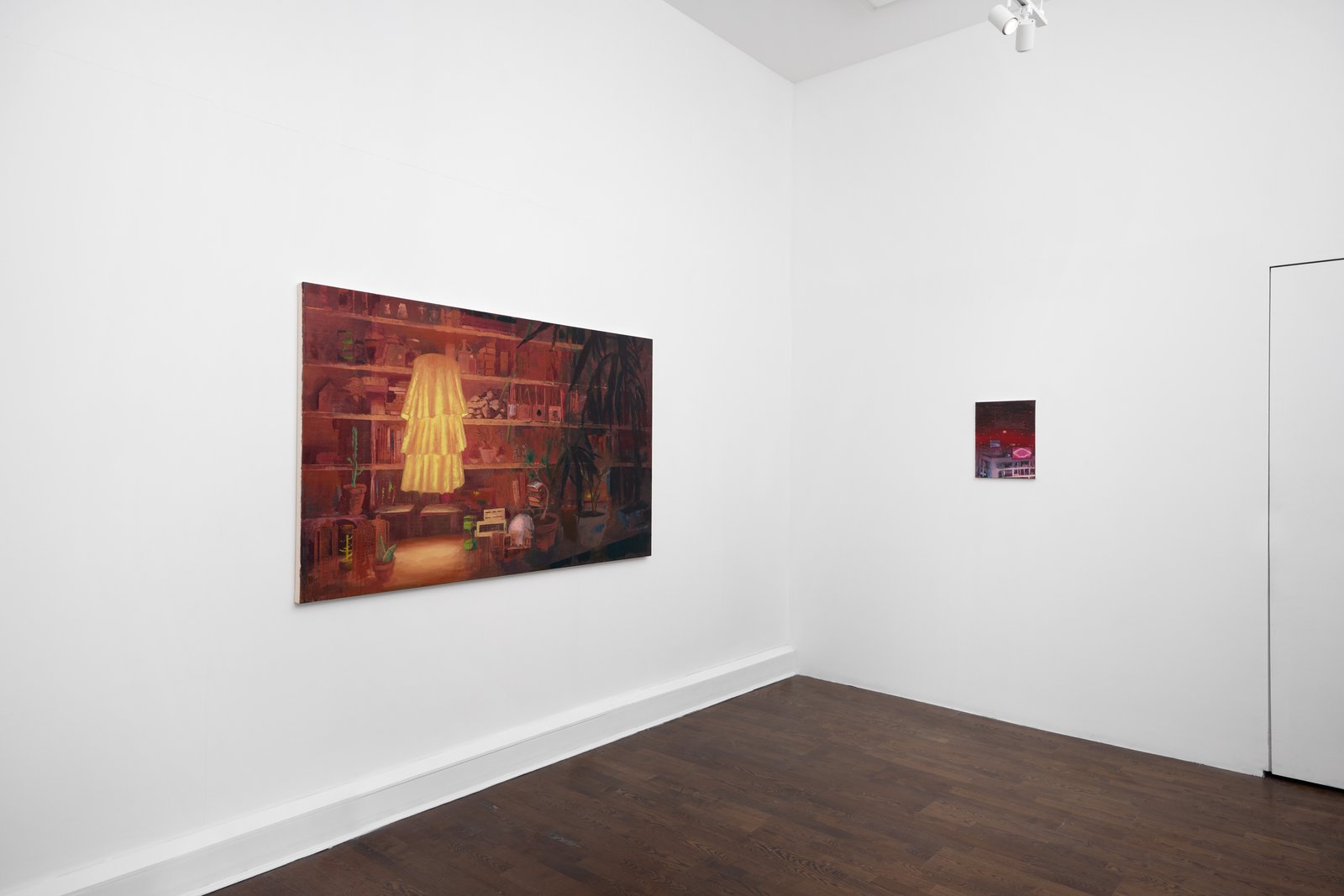
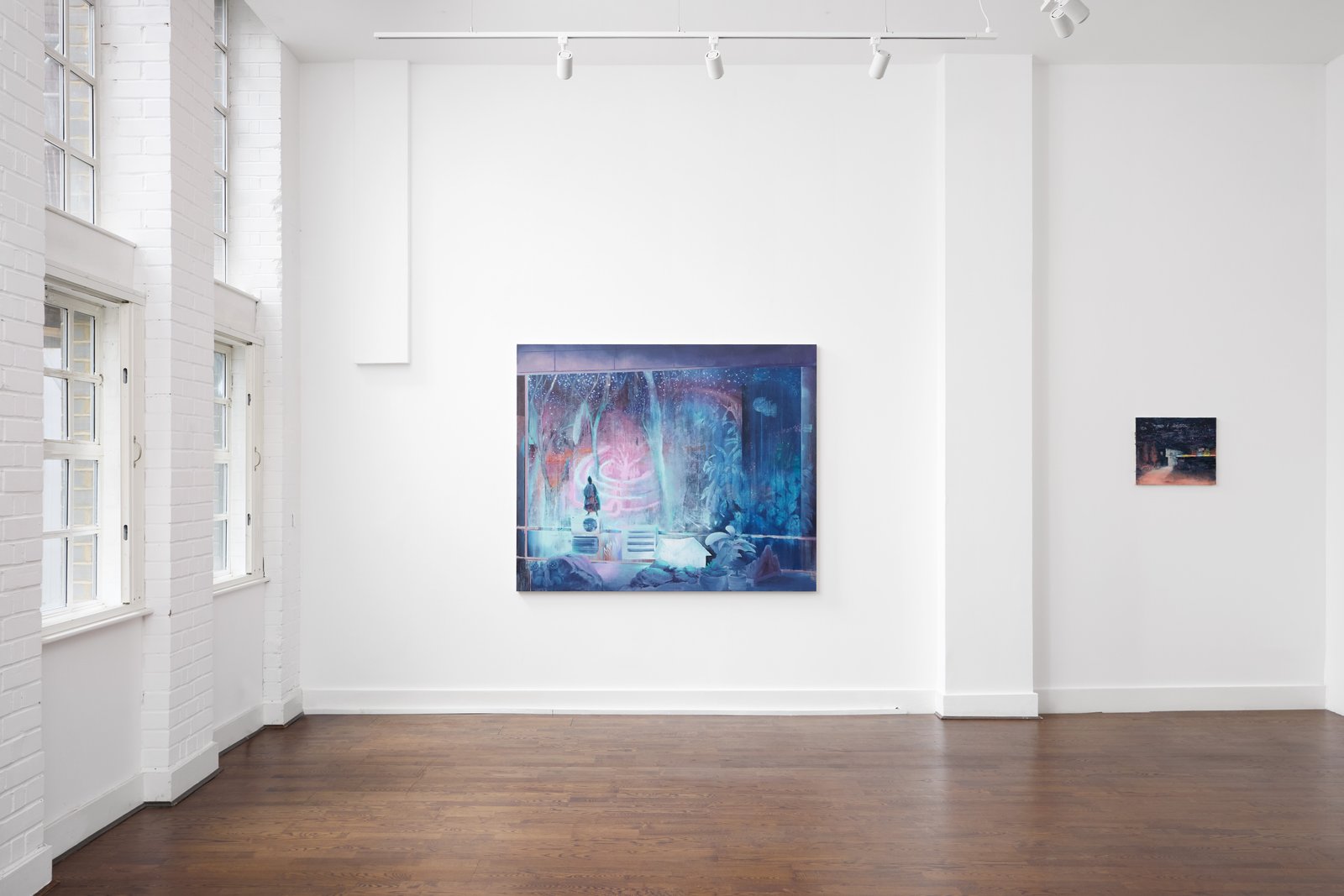
Is Mircea Teleagă the dreamer? Does he want us to live inside his dream? And if we accept the invitation, will we ever find a way out or will we, much like the potted plants and miniature houses, find ourselves trapped there? These are mini-worlds; dioramas, maquettes and models sit beneath a generalised image of a landscape. Whilst we can quickly identify many of the items in the paintings, we may not be able to identify where we are quite so readily. It could be an attic or basement where forgotten and discarded belongings eventually end up. Or maybe a production company’s props department, each object originating from some old B movie. Perhaps it’s a bunker laboratory that houses specimens and terrariums. We are continually converging and diverging between the forgotten, the examined and the made-up. There is, at first, an acceptance and understanding of illusionistic space, but this breaks down as viewpoints change and contradict each other as we slowly traverse across the painting. The spatial logic becomes untenable, the agreed pictorial conventions of describing three-dimensional space on a two-dimensional plane seemingly ignored in favour of multiple perspectives. The miscellany of objects also comes with a miscellany of locations, split between a Renaissance human centric view and a Medieval God’s eye view of the world.
“When we try to pick out anything by itself, we find it hitched to everything else in the Universe.”
John Muir
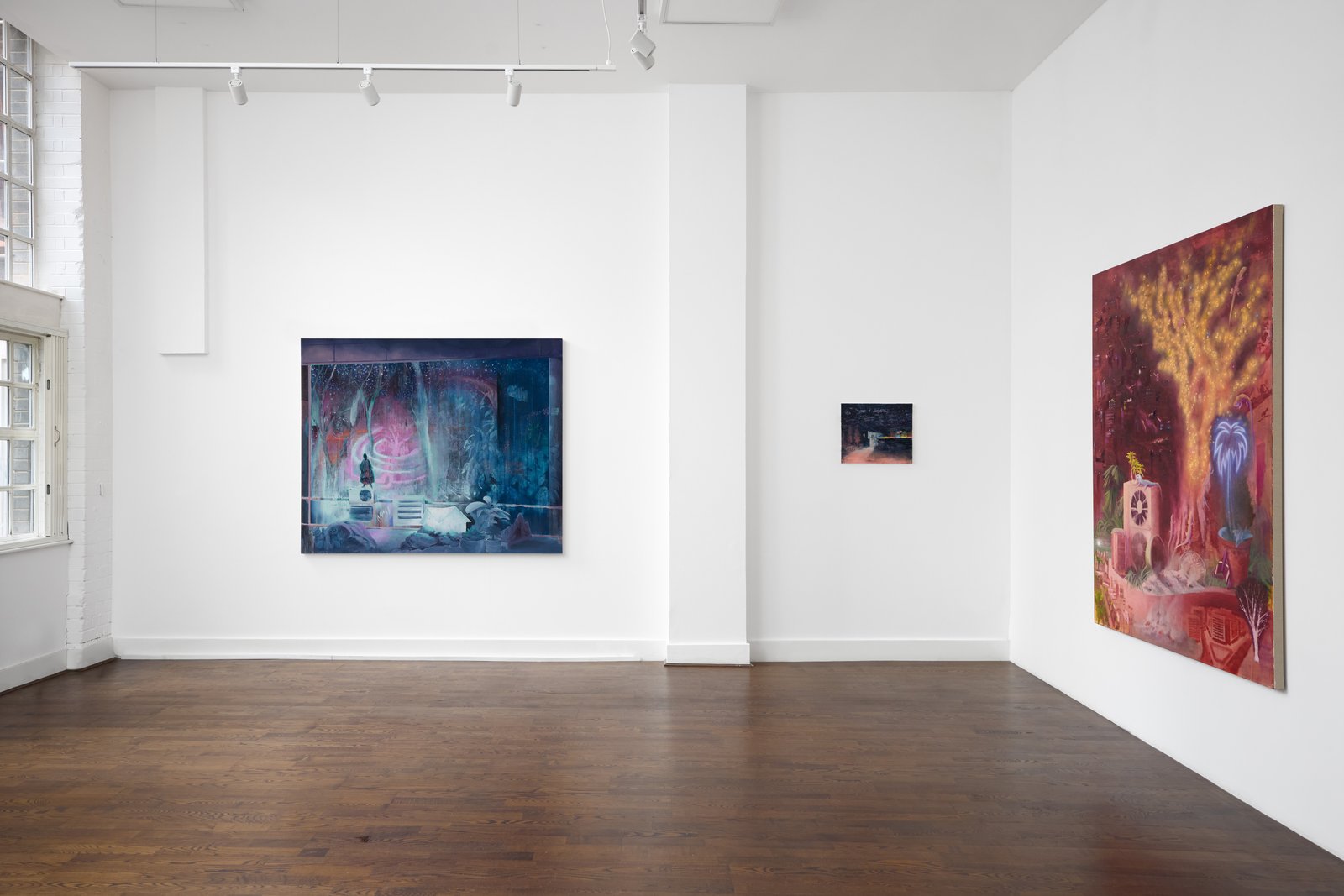
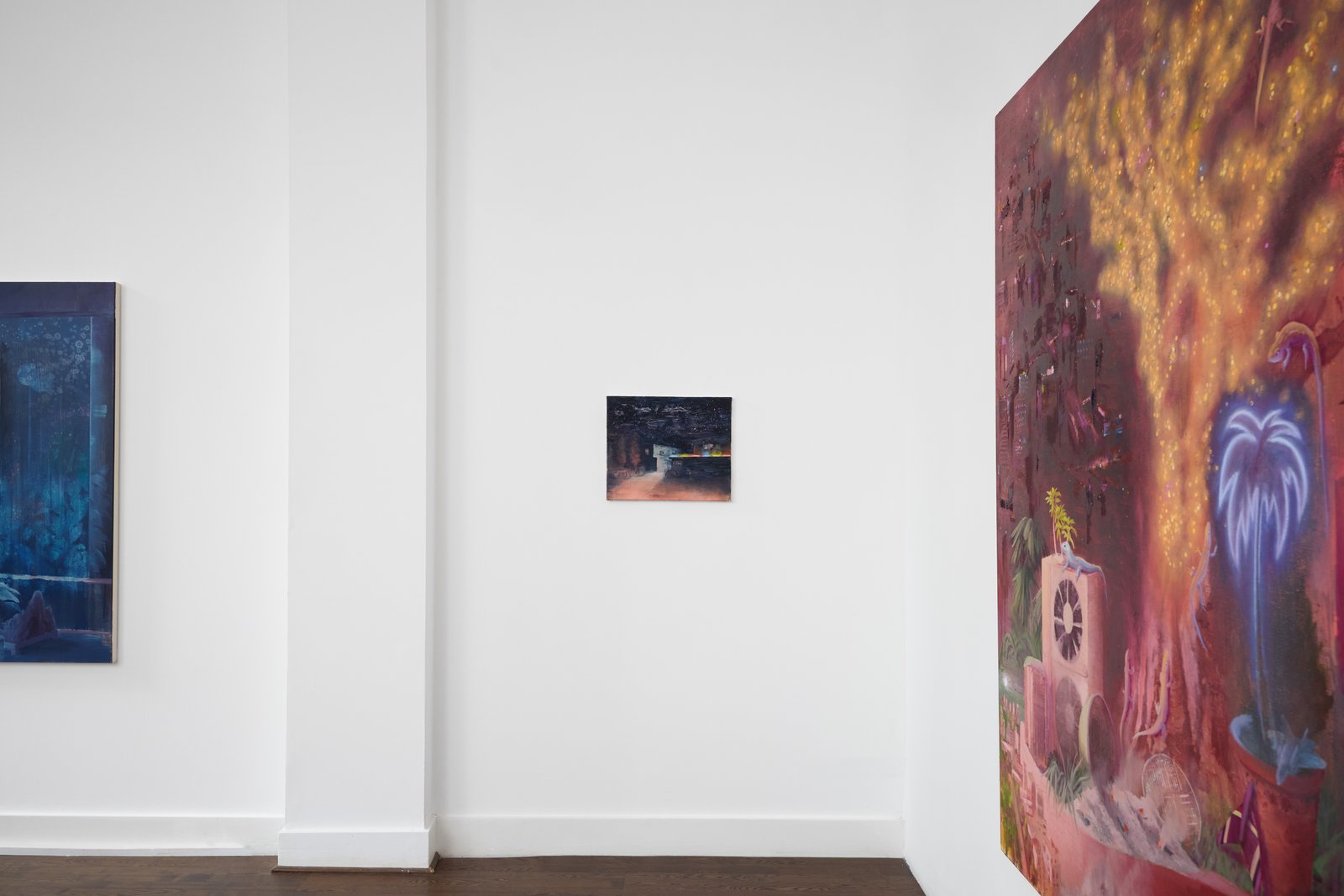
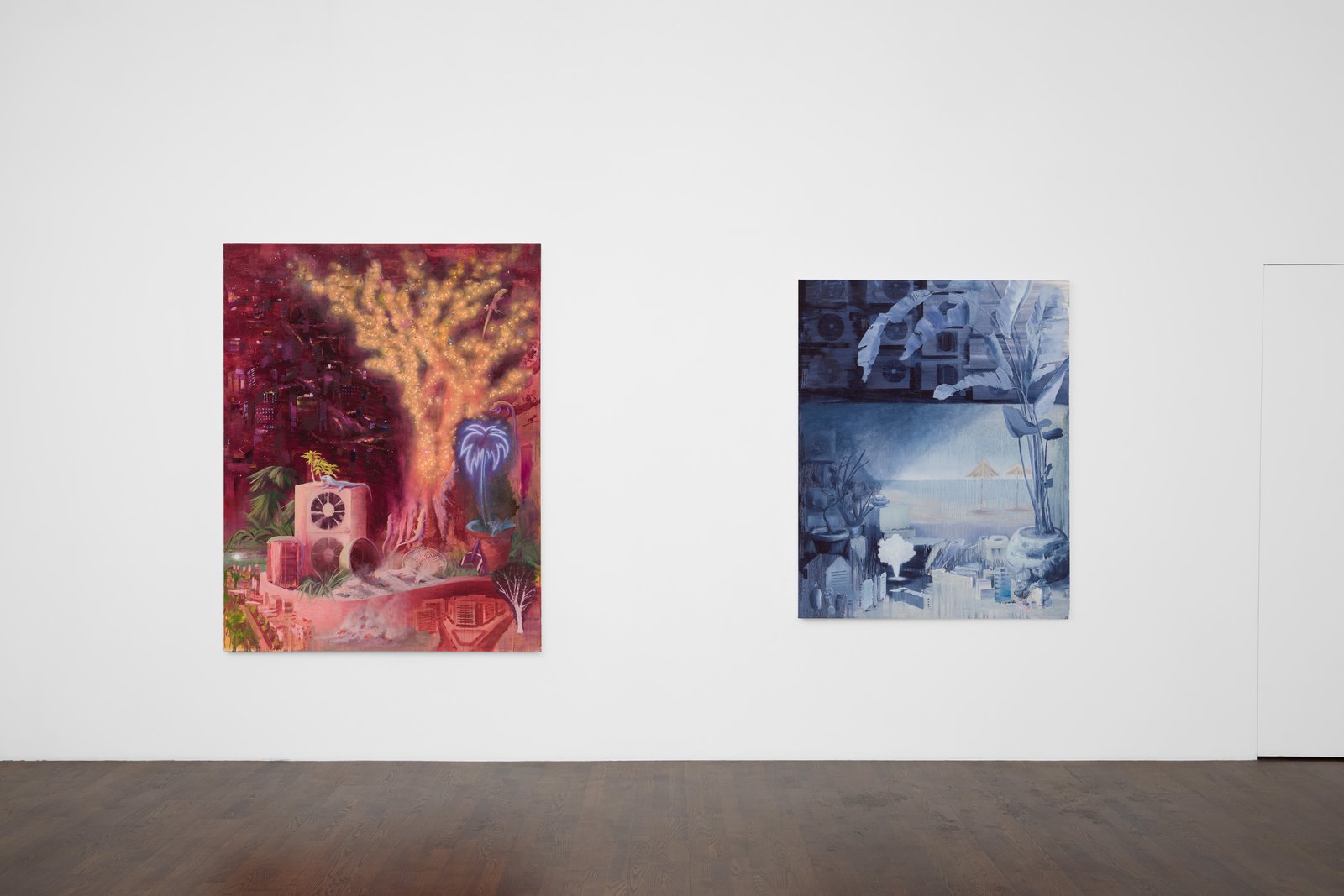
In ‘Rooftop Paradise’, a recently used barbecue has been knocked over; the ash from the charcoal not yet extinguished. The largest of the different tree species here is composed of small round dots indicating that it’s completely lit up, or possibly even alight – the embers from the barbecue spreading upwards and forming a branch-like pattern. Immediately to the right, there is a potted neon palm tree; another means of how an image could be lit. These trees and surrounding plants serve as a buffer, a means of consoling the painted space, as one would console their home or office by decorating it. On one side of the painting, there is a horizon tucked closely in and, on the other side, two types of aeroplanes. Inside these paintings there is always the possibility of a departure; a quick exit out of this peculiar environment we find ourselves in and hopefully towards a new destination. A further away future rather than an immediate present. Unfortunately, these planes are only toys to be held in our hands, used as a vehicle for one’s imagination rather than as a vehicle of any other kind.
Cinema casts a shadow of its own over these paintings. That isn’t to say the paintings are outwardly cinematic in their references, nor in their format and framing. The influence of cinema has surreptitiously and obliquely stepped in; our eye pans along the bottom edge, zooming in and out of the distant panoramas. A high angle shot transitions into a POV shot without us even noticing. There is no plot to follow, only individual montages that may – or may not – form a sequence and a chain of events without start or end. A cyclical non-duration. These paintings entreaty us to move slowly, we can only take one step at a time rather than darting from one part to the next. There’s as much movement in stillness as there is in action. Inaction has a different potentiality, an atmospheric tension gains a momentum, but the pressurisation never fully reaches its peak as it eventually plateaus and finds an uneasy stability.
“We usually use light to illuminate things. I am interested in the “thingness” of light itself. Light does not so much reveal, as it is the revelation itself.”
James Turrell
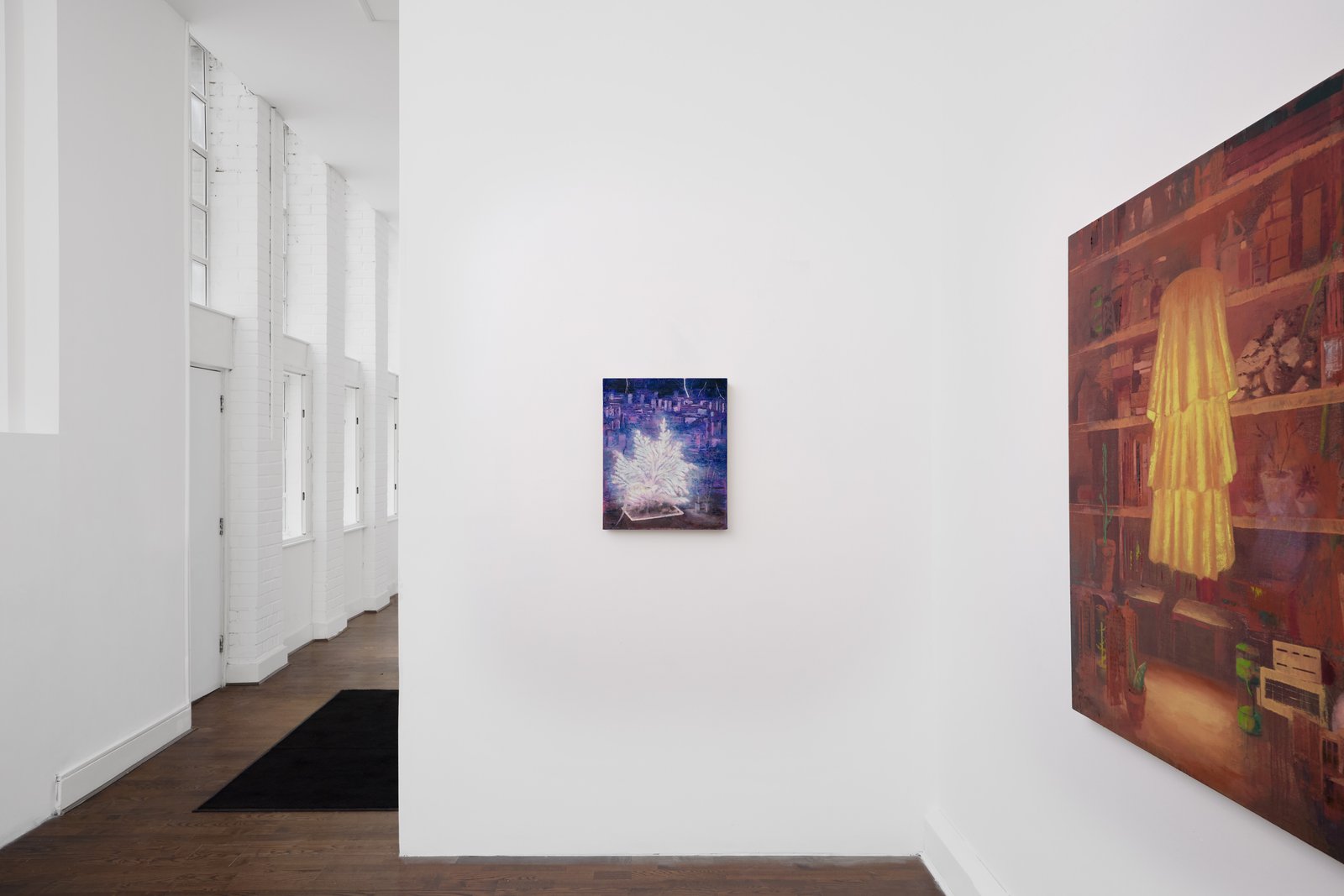
A subject in Teleagă’s work is the deployment of light and, in this new series of paintings it’s become an artificial, intermediate sort of light. These paintings are meditations on light as much as anything else; objects self-illuminate, neon signs shimmer and suspended forms release soft halos. It becomes almost self-referential in that respect, the paintings lighting themselves as much for our benefit as for their own. As described by James Turrell, light has a ‘thingness’ that Teleagă regularly exploits in his work. It claims its existence. In ‘White Flowers’, paint has been poured, travelling down the surface of the canvas. It is an act of painting; where material meets gravity, shifting between pure process and narrative potentiality. It reads as rays of hesitant light, but also as veils of lava dropping over the botanical arrangement immediately underneath. We have two opposing urges present within this painting: the weight and pressure of the light/lava bleeding downwards contrasting against the inherent impulse of plant-life to advance upwards approaching the possibility of direct sunlight. Ascent and descent cross over.
These are paintings that covertly desire to transmit sounds and noises from within the boundaries. Cracking, humming, beeping. The constant whirring of the air condition units and the buzzing of fluorescent bulbs always on the cusp of audibility. A tolerable cacophony of sound to parallel the incongruity of the places we encounter before us.
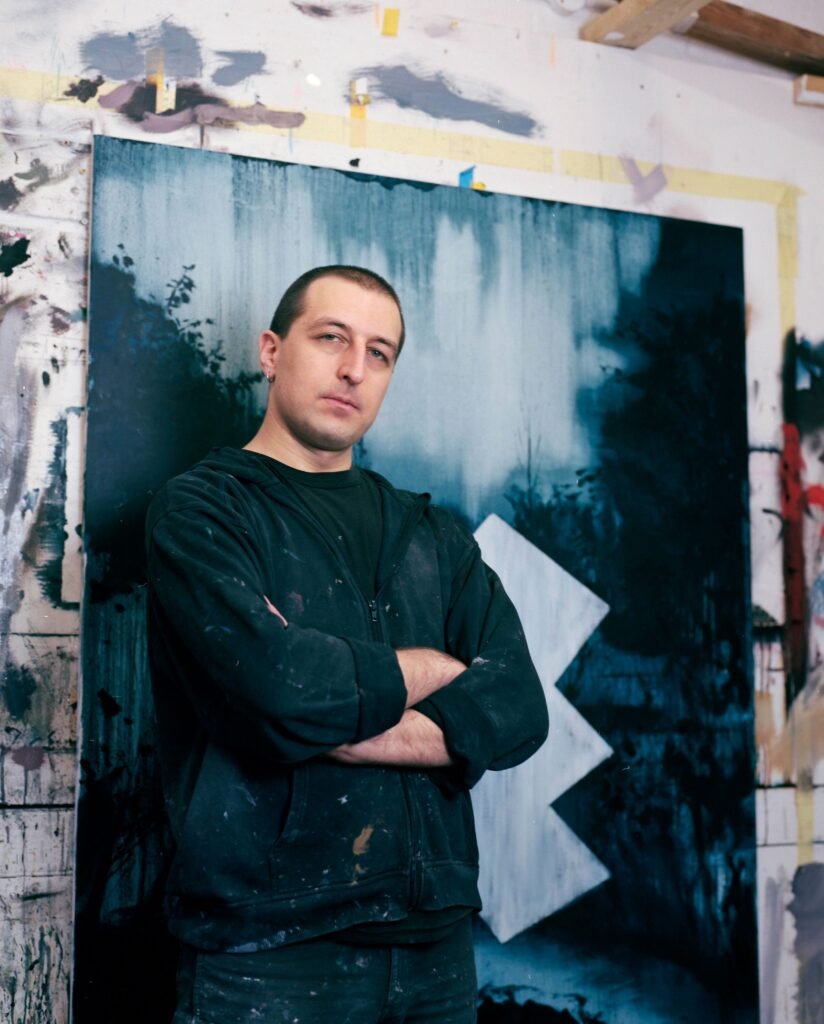
Teleagă paints by covering the canvas with various washes, staining and spreading preferred pigment mixes, such as quinacridone deep pink. From here, he maps out the paintings by placing, ordering, lighting. He uses what you may expect from a painter; brushes, palette knives and rags. But also, the more atypical credit cards and chopsticks; each tool picked up gives part of itself over to how the painting operates, expanding the type of mark-making and surface rendering now available. The paintings are relatively unlaboured and relaxed, despite there being constant revisions and compositional updates. A characteristic of Teleagă’s painting is the collocation of soft and hard edges. Edges separating figure from ground, light from shadow, formlessness from form. He describes painting as “mirror-making…an honest way of working, painting is this giant eye above you that keeps track of what you do” and so whatever happens as part of the making-process remains discernible to some degree. The painting gives us not only what is currently present, but that which was once there and since gone. Almost as if the painting is persisting in trying to remember erstwhile parts of itself.
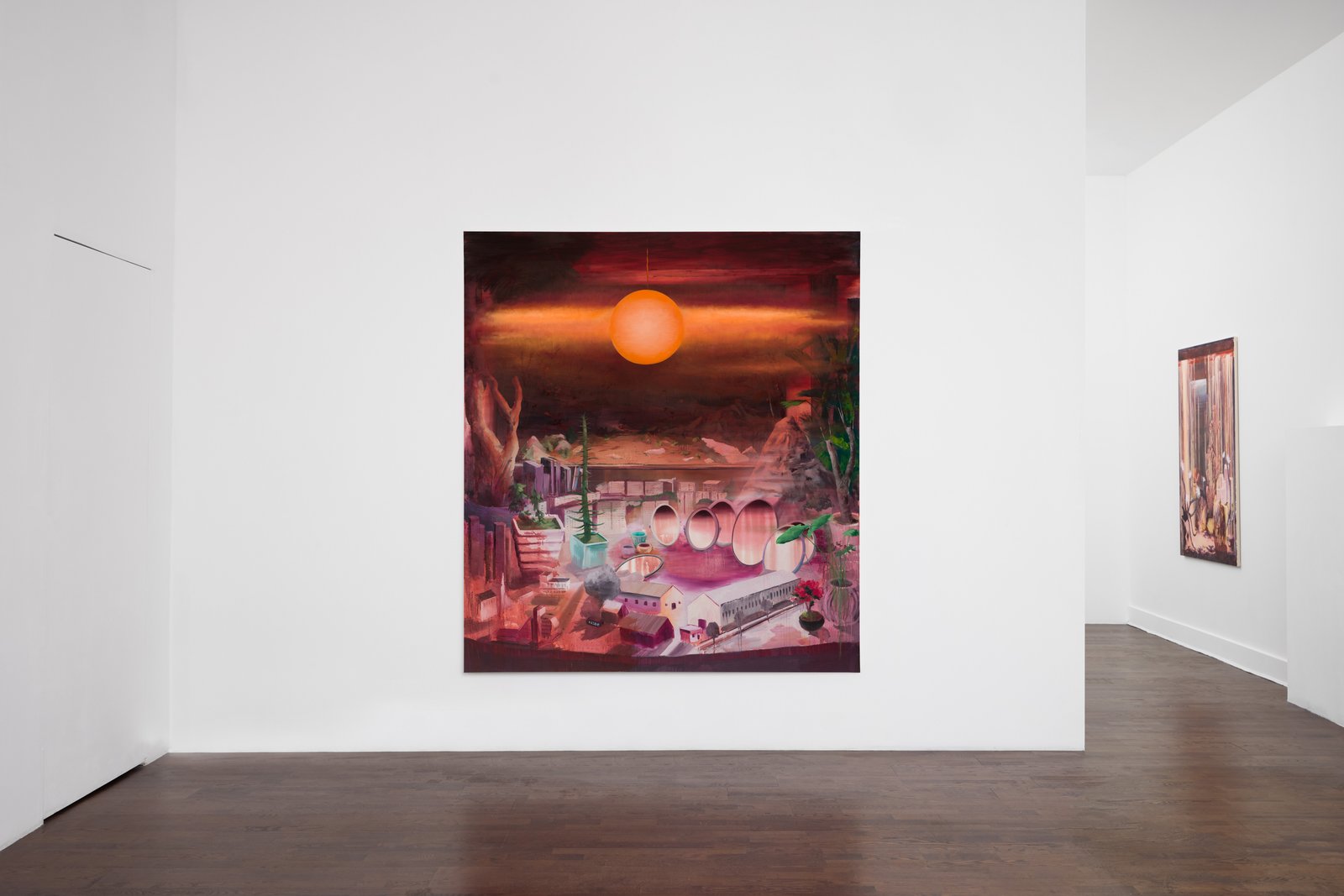
Teleagă predominantly works on a larger canvases, although lately he has been making smaller paintings where the image is not quite so fragmented in its construction. The space is more unified in how it reads; it is the one world rather than the multiplicitous worlds we find in the bigger works. In ‘Midnight Sun’, what at first appears to be a matter-of-fact scene of a high-rise building or multi-storey car park at night slowly divulges a central contradiction; a sun emerging overhead at midnight. Artifice returns. Another kind of fictive sun can be found in the painting ‘Blind Sun’. This particular ‘helios’, seemingly suspended from a wire, radiates a warming orange incandescence. The roundness of its shape correlates to the roundness of the seven oval mirrors positioned below, but rather than reflecting something recognisable from within the painting’s fictive space, it reveals a gradated void of dark magenta through to white. These mirrors open the picture out beyond itself without betraying the conceit of the painting. They reflect a non-space, a space that is accepted and coherent within the paradigm and rationale of painting (“mirror-making”).
The notion of paradise, of a promised land, undoubtedly points us towards religious and spiritual associations, however Teleagă is reaffirming a more secular view of what could constitute a twenty-first century version of paradise. Each element that could signify some idealised place or some revered state of being is itself a fragment, an incarnation of a something and a somewhere else. A stand-in. There is a believability in the supposedly unbelievable; the objects we see phase in and out of solidity, half-formed, half-remembered, half-located. It doesn’t truly feel paradisiacal, more like simulacra of the idyllic, where the promise of warmth and shelter have been eroded down to uninhabitable buildings and fictitious suns. But the paintings still give us something tangible to hold onto, even if it is artificial. Artifice has a truth and substance of its own. It’s not all smoke and mirrors after all.
“Does it occur to people that I may be artificial by nature.”
Maurice Ravel
Installation Views